The New Front Lines: Navigating the EU’s 2026 Mandate for Connected Vehicle Security

Oscar Törnebrant
May 26, 2026Share on:


The automotive industry has reached a definitive “point of no return.” In the first half of 2026, the EU’s NIS Cooperation Group released its seminal Security Risk Assessment of Connected and Automated Vehicles (CAVs). For cybersecurity executives, this isn’t just another white paper to file away, it’s a wake-up call that the goalposts of compliance and safety have moved.
For years, the industry leaned on UNECE WP.29 R155 and R156 as the gold standards. These regulations did their job: they ensured a vehicle was secure the moment it rolled off the assembly line. But as the NIS report bluntly points out, “factory-gate” security is no longer sufficient to stop organized, nation-state actors or malicious “intentional” updates designed to weaponize a fleet after it has been sold.
The perimeter has vanished. For a while now, the vehicle has been a node in a massive, shifting digital ecosystem. To protect it, we must look beyond the chassis.
Three Battlegrounds of European Public Safety
The NIS Cooperation Group has identified three specific asset groups that now represent the front lines of public safety:
1. The “Brains”: Vehicle Control & Decision Systems
We are moving from vehicles that assist drivers to vehicles that replace them. This shift places the crosshairs directly on ECUs, AI models, and sensor suites (LiDAR/Radar). The EU assessment warns of a chilling new reality: “Adversarial AI.” Attackers are no longer just looking for software bugs; they are targeting the training phase of AI models. By poisoning the data, a sophisticated actor could theoretically alter a vehicle’s decision-making logic, turning a fleet of autonomous shuttles into a coordinated public safety threat.
2. The Invisible Supply Chain Risk
A vehicle is a mosaic of third-party contributions. The 2026 assessment underscores that your security posture is only as robust as your weakest Tier-1 or Tier-2 supplier. A vulnerability in a lighting controller or a power management chip, often overlooked in traditional IT security, can provide the lateral movement an attacker needs to reach the vehicle’s safety-critical systems.
3. The Extended Perimeter: Communication & Cloud Infrastructure
The modern CAV relies on V2X and cloud-based telematics. This means the “perimeter” of the car now extends deep into the data center. When the cloud dictates a vehicle’s speed or location, a breach in a service provider’s API becomes a physical kinetic event on the highway.
Bridging the Gap with Deep AI-Powered Contextual Analysis
The EU’s findings demand a move toward ecosystem-level resilience. It is no longer enough to monitor the vehicle ; you must monitor the context in which the car operates. This is where Upstream bridges the gap between regulatory theory and operational reality.
The challenge for modern OEMs isn’t just detecting a hack; it’s maintaining situational awareness across millions of roaming data points in real-time.
Upstream addresses the NIS Group’s concerns through three core pillars of defense:
Behavioral Monitoring and XDR via Live Digital Twins
To counter the threat to Decision Systems, Upstream creates a live digital twin for every vehicle in a fleet. By establishing a “normal” baseline of telematics data, the platform can instantly spot anomalies. If a vehicle’s decision system begins to behave erratically, perhaps due to sensor spoofing or a poisoned AI model, the digital twin flags the deviation immediately. This allows for effective investigations and mitigation.
Proactive Cyber Threat Intelligence
The supply chain is a dark forest. Upstream’s AutoThreat® intelligence unit illuminates it. By tracking thousands of active threat actors, including well-funded and large scale criminal groups, across deep and dark web sources, Upstream allows organizations to see if a newly discovered risk in a niche supplier’s library affects their active fleet. This transforms reactive patching into proactive risk management.
Real-Time AI Security
As the EU noted, the cloud is the new front door. Upstream monitors MCP traffic and billions of API transactions made by AI systems, mobile apps and third-party services. This ensures that sensitive commands are not only authenticated but haven’t been manipulated mid-transit.
The Agentic Path Forward: From Compliance to Resilience
The EU’s 2026 assessment makes one thing clear: the era of “set it and forget it” security is over. Cybersecurity executives must now manage a living, breathing ecosystem.
By centralizing data from the vehicle, the supply chain, and the cloud, Upstream provides the situational awareness and agentic large-scale capabilities the EU now mandates for public safety. We are moving toward a future where the goal isn’t just a “secure vehicle,” but a resilient transportation network. In this new landscape, the winner isn’t the one with the thickest firewall, but the one with the clearest view of their entire digital horizon.
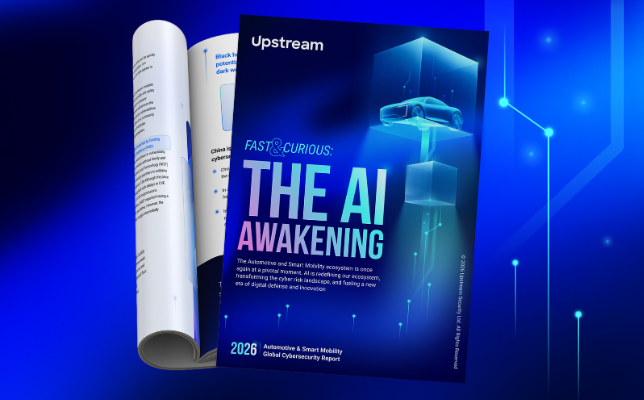
The AI Awakening – 2026 Global Automotive and Smart Mobility Cybersecurity Report
