How Did Your AI Agents Behave Today?
Runtime AI & API Security solution helping security teams discover AI agents, MCP and API traffic, monitor their context, behavior and intent in production, detect real-time threats, and automate investigations, threat hunting and response.
Request a Demo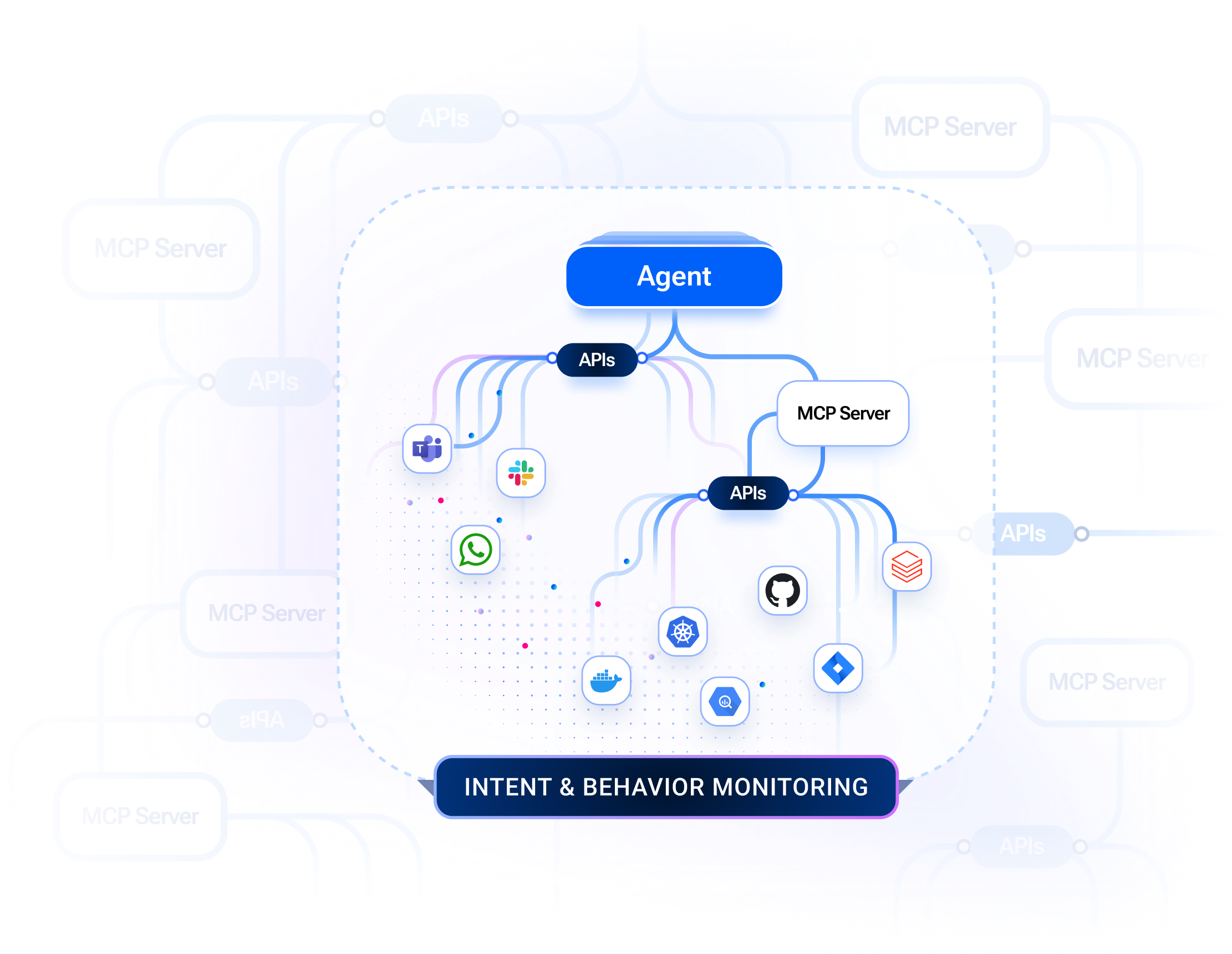
Stateful detection, analyzing AI agents, MCP and API traffic alongside operational data streams to protect the full data-to-action pipeline.
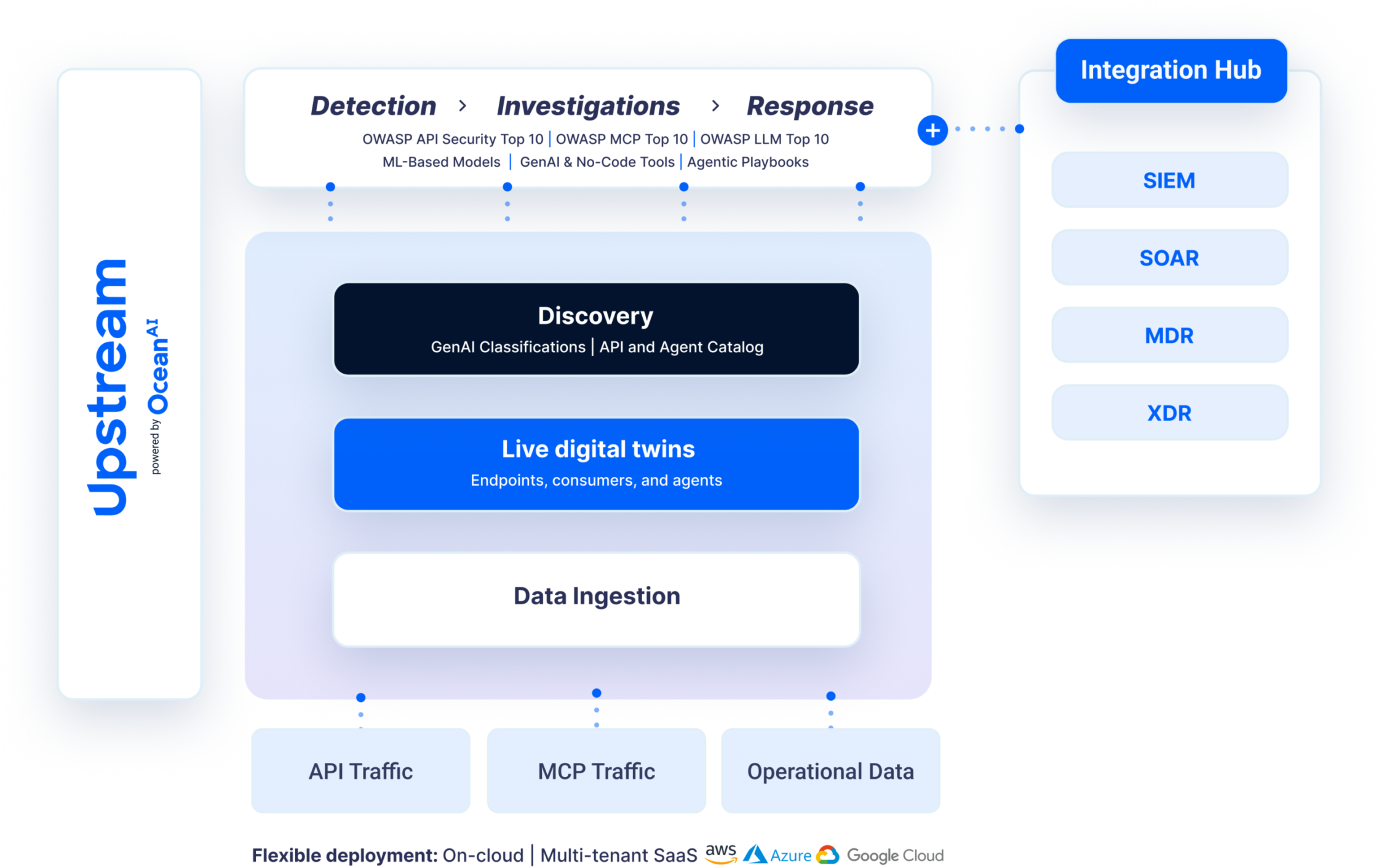
Upstream’s live digital twins maintain a historical, contextual and behavioral representation of assets, endpoints, consumers, and agents. The platform monitors all traffic and provides a stateful analysis across the entire ecosystem, supporting a more comprehensive and resilient cybersecurity posture.
Built for Massive Scale and Complex Environments
Proven to ingest and analyze billions of monthly API transactions and MCP traffic, the platform can be flexibly deployed as SaaS or in customer cloud environments to meet data sovereignty and regulatory requirements.
Advanced Cross-Ecosystem Discovery and Behavior Profiling
Comprehensive discovery of API endpoints, consumers, MCPs and agents to ensure full coverage. The platform also profiles assets over time for deep contextual analysis.
Stateful Threat Detection
Live digital twins build stateful models of assets, developing behavioral baselines and powering ML-based threat detection that infers attack sequence and intent across the full execution flow.
Threat Hunting, Investigations, & Response
Ocean AI, Upstream’s AI layer, delivers LLM-powered security workflows for low-and-slow or unknown risks, enabling teams to query data, extract insights, triage, and build agentic runbooks.

Automated discovery and catalog
Identify, classify, and monitor all agent, API and MCP traffic.
Upstream builds and maintains a comprehensive inventory of all assets by ingesting traffic and logs to uncover undocumented tools, shadow assets, and zombie resources. Using AI-powered classification, the platform maintains a live catalog of functional relationships, sensitive data exposure, and high-risk surfaces.

ML-based detection
Apply runtime analysis of context, behavior, and intent to surface known and unknown threats.
Using the live digital twin and Ocean AI, Upstream applies stateful, ML-powered behavioral analysis to detect anomalies and attack patterns. By correlating API transactions and MCP traffic with inferred intent and behavioral baselines, the platform identifies anomalies, business logic manipulations, or sequential activity indicative of sophisticated, automated or low-and-slow attack chains. Coverage includes OWASP Top 10 for API Security, MCP and LLM, with flexibility provided through a no-code detection builder for customer-specific logic.
GenAI-powered and agentic triage, investigations and threat hunting
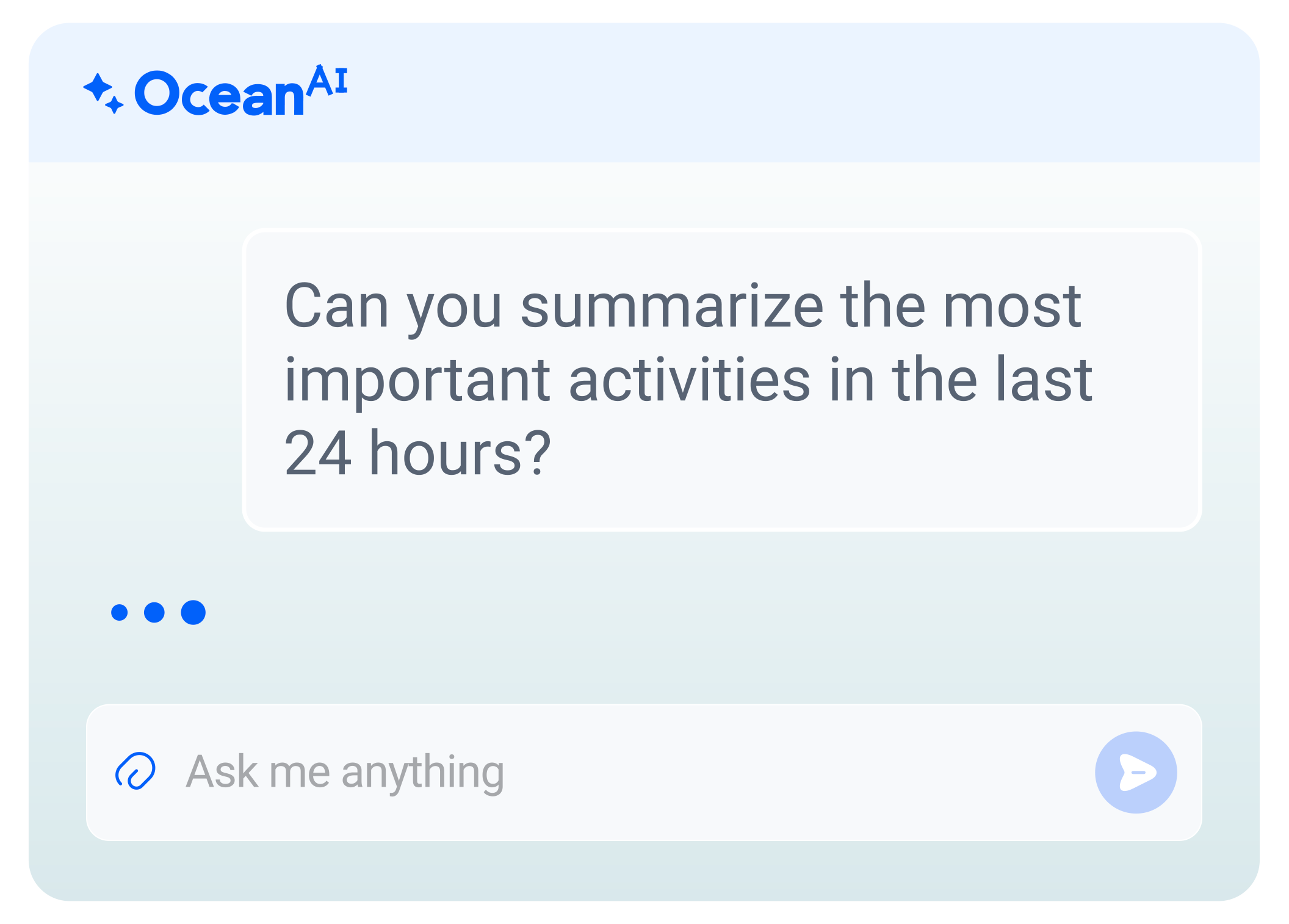
Reconstruct events and understand impact with conversational querying.
Provides full transaction context and history, including across-asset correlation to trace evidence and anomalies. Intent and behavioral baselines, agent-to-tool interaction chains, and live digital twin signals reconstruct event chains to validate anomalies and power proactive threat hunting. Ocean AI supports natural language investigations with data classification, alert interpretation, triage, and querying.

Effective response and agentic remediation
Coordinate remediation through integrated workflows and automated runbooks.
Upstream connects with SIEM, SOAR, WAFs, API gateways, and other enterprise systems to support automated or human-in-the-loop remediation. Actions can include blocking or isolating consumers or agents, revoking tokens, adjusting rate limits or policies, and sending enriched alerts to external systems.
API Security Frequently Asked Questions
AI and API security are all about context, and often risks can only be detected when analyzing sequences of actions and correlating them with the impact or consequences. Upstream provides the necessary context and continuity across the full execution flow to prevent malicious operations that appear benign when viewed as disconnected steps.
A typical WAF is stateless and examines transactions one by one. Upstream uses proprietary live digital twin technology to build a stateful, contextual analysis of endpoint and consumer behavior. This allows the platform to detect complex, low and slow attack chains that look like legitimate traffic to a standard WAF.
Foundational visibility is the core of our platform. Upstream automatically constructs a comprehensive API inventory by ingesting traffic, documentation, and operational logs. This process uncovers all active endpoints, including undocumented, shadow, and zombie APIs. It continuously updates the catalog to classify data exposure and functional relationships.
Upstream monitors AI agents in real-time to ensure their actions are safe and secure. By tracking relationships between agents and their physical impact, the platform detects deviations like prompt injections that alter system behavior.
Yes. Beyond an extensive and pre-configured set of detectors, all of which are customizable to meet specific requirements, the platform includes a no-code and GenAI-powered detector builder. This allows your team to create tailor-made detectors for unique business logic, misuse attempts, or operational risks without writing a single line of code.
No. Upstream is designed as a cloud-native solution with a zero latency impact. The platform typically ingests data via traffic mirroring from your gateway, load balancer, or a lightweight agent. This ensures your critical applications remain fast and responsive while under full security monitoring.
Ocean AI offers purpose-built GenAI and Agentic AI tools to streamline investigations. Analysts can use natural language querying to reconstruct event chains and understand the root cause of an anomaly quickly. It provides GenAI-driven summaries and alert interpretations, helping your team determine the scope and impact of threats at scale.
We offer flexible deployment to meet your specific regulatory and PII requirements. You can choose a multi-tenant SaaS model or deploy directly within your own private cloud environment. The architecture is built for massive scale and can process billions of monthly API transactions across various infrastructures.
More to dig into
Impact of PCI DSS on API Security For Mobility Products, Apps, and Services
Read more

Beyond the Cyber Resilience Act: Building Holistic Cyber Resilience
Read more
Rethinking the Perimeter: BOLA and the Illusion of the Legitimate Request
Read more
Rethinking the Perimeter: Excessive Data Exposure and the Outbound Blind Spot
Read more
Rethinking the Perimeter: The Hidden Blast Radius of “Harmless” Endpoints
Read more
APIs in the Driver’s Seat: AI Agents and the Future of Automotive Cybersecurity
Read more
Upstream Safeguards Autonomous Vehicle Technology with May Mobility
Read more