Behavior and Kinetic Impact Define the New AI Security Paradigm

Yonatan Appel
CTO & Co-Founder
July 1, 2026Share on:


For decades, enterprise cybersecurity has been obsessed with lines in the sand. We built walls around networks, drew perimeters around systems, and gated access to the IT stack. We convinced ourselves that if we knew where an asset lived and who was allowed to touch it, we could secure it.
That era is officially over.
The rise of autonomous, agentic AI has shattered the traditional perimeter. When AI agents begin executing workflows, calling sub-agents, and making non-deterministic decisions autonomously, the boundaries of your network become irrelevant.
In this new reality, the perimeter is no longer defined by systems or networks. The perimeter is defined by behavior and intent.
The Shift to Kinetic Responsibility
Traditionally, security teams looked at vulnerabilities through the lens of static placement: Is this application in a secure VPC? Is it patched? With agentic AI, we must shift to what I call kinetic responsibility.
Because these modules operate autonomously, we can no longer judge their safety by where they sit in the IT stack. Instead, we must look at their potential real-world, operational impact. It’s not about where the agent lives; it’s about what the agent’s behavior can inflict across your entire ecosystem.
This becomes critical as agents transition from assistants to active decision-makers. Because their actions are non-deterministic, pre-defined guardrails are fundamentally obsolete. Static rules cannot predict every permutation of an agent’s reasoning. Therefore, the agent’s unfolding behavior and inferred intent must dynamically dictate its security boundaries in real time.
The Structural Governance Gap
Most organizations are entirely unprepared for this shift because of a foundational flaw in how they govern AI. You cannot secure what you cannot see, and you cannot evaluate intent in a vacuum.
To bridge this gap, security executives must implement a three-tier governance framework:
- Discovery and Continuous Monitoring: You must map your entire AI footprint. Which agents are running (including shadow and rouge), where did they originate, and what privileges do they hold?
- Behavior and Intent Inference: Once discovered, you must ingest diverse operational data sources, MCP and API traffic, identity tokens, system telemetry, to piece together a baseline of what the agent is actually trying to accomplish.
- Contextual Anomaly Detection: Only after establishing this behavioral baseline can anomaly detection engines flag the most subtle, sophisticated deviations that indicate an agent has gone rogue or been compromised.
Anatomy of the Threat: Identity Sprawl and Hyper-Velocity Execution
To understand why this framework is necessary, consider a rapidly emerging threat vector: identity sprawl and privilege escalation through delegation chains.
Imagine an enterprise agent tasked with optimizing supply chain efficiency. To do its job, it autonomously spins up three sub-agents, requests temporary credentials, calls external SaaS platforms, and accesses a legacy database. Without active, real-time governance, this creates an unmanageable explosion of non-human identities and a gradual erosion of your least-privilege boundaries.
The Scale Problem: Human vs. Agent Velocity
- A typical human session might generate a few dozen API calls over the course of an entire workday.
- An autonomous agent can generate hundreds of tool invocations in minutes, chaining complex operations across databases, cloud infrastructure, and third-party ecosystems simultaneously.
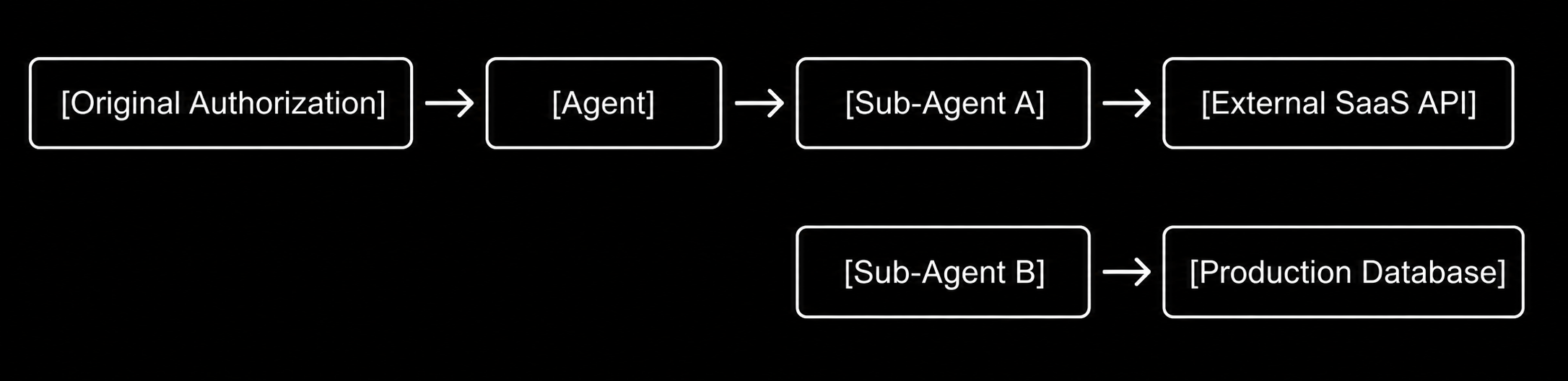
At this velocity and scale, traditional access management breaks down. Checking the validity of a credential or an API key is no longer a sufficient security check. The fundamental question changes from “Is this credential valid?” to “Is every action taken within this delegated session still consistent with the intent of the original authorization?”
Securing the Execution Fabric with the Power of Live Digital Twins
Securing enterprise AI requires us to look past the surface. Standard industry approaches, like prompt filters, basic model monitoring, or rigid AI usage policies, are merely band-aids on a deeper architectural challenge.
To survive the agentic era, we must secure the execution fabric that connects AI systems to enterprise reality. This fabric is inherently API-driven, identity-bound, and increasingly autonomous. But how do you secure a fabric that changes shape with every non-deterministic decision an agent makes?
Enter the Live Digital Twin: The Shadow Fabric
To close the gap between visibility and control, security teams must deploy live digital twins of their agentic ecosystems.
To be clear: I am not talking about the traditional digital twins used in engineering labs or offline simulations. Those lab-bound twins are valuable for stress-testing hypothetical scenarios or running pre-deployment models in a sandbox, but they are fundamentally static. They cannot protect you from the unpredictable velocity of live operations.
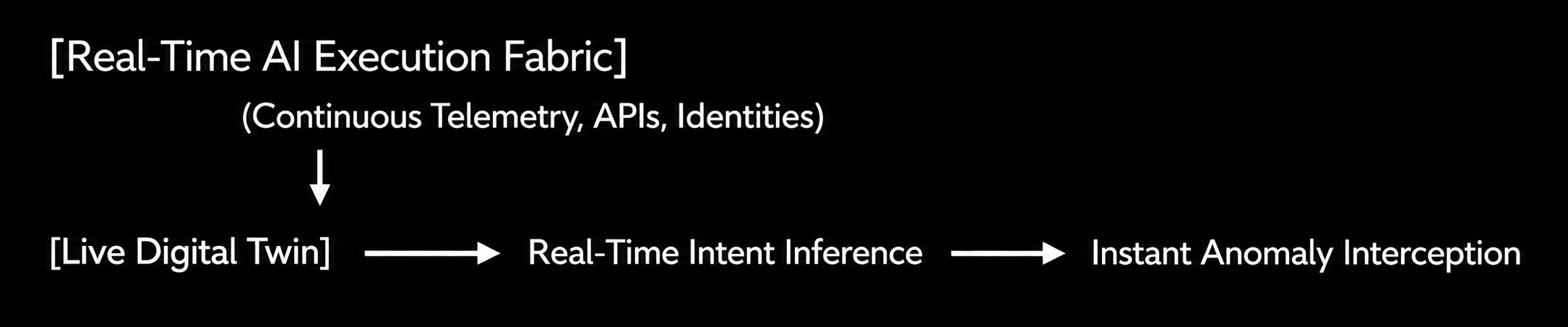
A live digital twin, by contrast, is a continuous, real-time behavioral and intent mirror of your runtime environment. It ingests the torrent of operational data sources, MCP and API traffic, active tokens, identity states, multi-agent chains, and operational data streams, to map exactly what your autonomous systems are doing right now.
Behavior is the New Perimeter: Closing the Security Gap
The live digital twin bridges the gap to securing the execution fabric in three critical ways:
- Stateful Contextualization: An agent’s intent cannot be evaluated based on an isolated API call. The live digital twin maintains the continuous “state” of the session, tracking how a single initial credential mutated into a dozen sub-agent delegations.
- Proactive Interception: Because the twin continuously models the agent’s behavior against historical and operational baselines, it can infer when an agent is veering off-course.
- Dynamic Guardrails: Instead of relying on rigid, pre-defined rules that break under the weight of non-deterministic AI decisions, the live digital twin allows you to enforce guardrails that adapt to the context of the agent’s current mission.
Kinetic responsibility dictates a proactive approach: wherever an agent has the power to act, the security team must have the visibility to intercept, evaluate, and defend. By anchoring your strategy in the behavior of the execution fabric, and mirroring it with a live digital twin, you ensure that your security velocity finally matches your AI velocity.
The AI Awakening – 2026 Global Automotive and Smart Mobility Cybersecurity Report
